05 May – Listening in Cottingley
By Joe Burns, Commission Member
Just prior to Christmas the Commission held a ‘Listening’ event at Wheeler Hall, Leeds. People coming along welcomed the opportunity to share their varied social justice concerns and we determined that, as a Commission, we should hold further events like it.
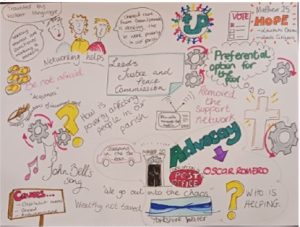
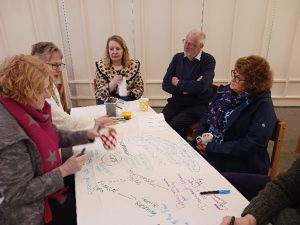
At the end of April, we met at St Mary & St Monica Church in Cottingley. This time we had a specific issue to focus on: UK poverty. Thanks to Liz Firth, who organised this event, our tables were covered with tablecloths that could be written on – and this we duly did!
What we know and have experienced.
There was a lot of experience in the groups from people who volunteered with the SVP and some who were involved with the ‘Community Kitchen’ in Bingley. Others were involved in supporting refugees and asylum seekers, many of whom have no recourse to any benefits. The church we were in supported the night shelter for asylum seekers run by Inn Churches in Bradford.
Bingley Community Kitchen started out as a kitchen – providing ‘cook and eat’ sessions and, during the pandemic, cooking meals for delivery to people. An important aspect of their work now is a ‘pantry’ style organisation where people pay £5 each visit and they can choose a number of items to take for that (along with some additional items that are freely offered). In addition, £1 of that amount is put into a Credit Union account for that person. There is also a café so that people coming to the community Kitchen can stop and have a chat with others.
Root causes
When we examined root causes of poverty then a lot of it came down to UK Government policy. This has been much more than just financial cuts. The harsh attitude towards migrants and asylum seekers has been well documented. Some also pointed to the difficulties involved in actually claiming a benefit such as Universal Credit: it is a complicated process to navigate. On top of that it can take several weeks before payment comes through, and many people claiming do not have any savings that they are able to fall back on in such circumstances. Others pointed to increasing cases of people in rented accommodation. Several also cited examples of service rationing’ – a good example being mental health services where the current waiting list for services is 1.9 million people and so the criteria for actually getting support are set in such a way that only very acute cases get help quickly. Charities are now covering the gaps in statutory services like these. Those helping people on low incomes should be plugging short-term gaps – not providing a way for Government to permanently reduce the
welfare budget.
What actions provide hope?
When it comes to what additional actions we can take, the looming General Election came into play. How do we apply the principles of Catholic Social Teaching?
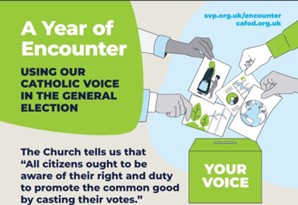
In considering the ‘Common Good’, John Battle pointed out that CAFOD and the SVP nationally have collaborated to produce a whole programme in preparation for this.
The ability to fully participate in society and to do that with full human Dignity should also be part of our decision-making. When we were talking about what sort of actions, we found hopeful then the Bingley Community Kitchen was certainly one of them: it sounded like a real attempt to provide help with dignity. It provides food for individuals and families very cheaply, which is helpful in itself. Additionally, the people using this service make their own choices about what to take – it is not a handout. By using a small proportion of the money paid to put into a
credit union account the service also offering a ’hand up’ to people who do not have income levels allowing them to save on a regular basis.
We didn’t solve anything in our discussions in this meeting but I think everyone found out something they didn’t know before they came along or were given ideas for things that they could do differently. When we went round at the end to see if individuals had any comments, more than one person mentioned how helpful it was to be able to be in a group where such a discussion could take place. Others mentioned the language we use and fall into the trap of using and accepting: the ‘cost of social welfare’ as opposed to the amount we ‘invest to help people live a more dignified life where they can fully participate’. All of this was captured in visual form by Bronagh Daly, from Our Lady of Kirkstall parish & Leeds Church Institute (as shown at the start of this article). She did the same thing at our pre-Christmas event and worked so well that we asked her to do it again!
This format of event is something which we will continue to repeat later in the year. Email the Commission if you would be interested in hosting a session in your area.
CAFOD-SVP Encounter Programme
 There will be a Fairtrade stall and a plant andseed swap stall. If you have any excess seedlings or seeds then you can bring somealong and swap them for something else! There will also be a stall about howmicroplastics are affecting our food.
 CAFOD and the SVP have joined forces to help prepare the UK Catholic community for the upcoming General Election. Their introduction to this campaign is as follows: