The material for this post appeared in the March 2016 J&P Newsletter
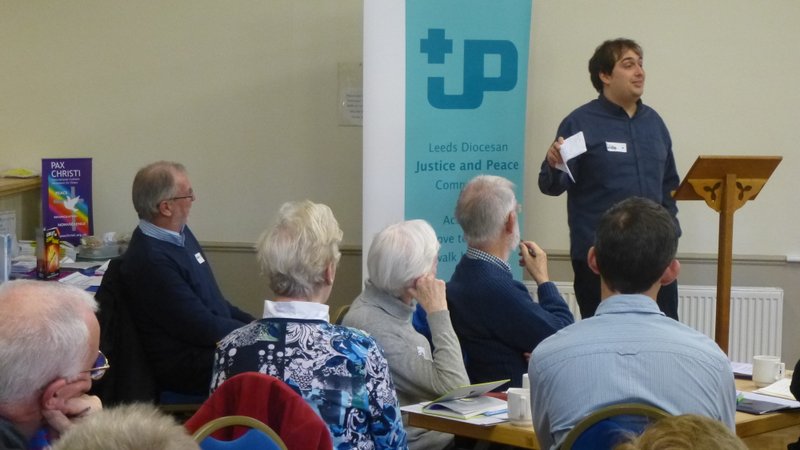
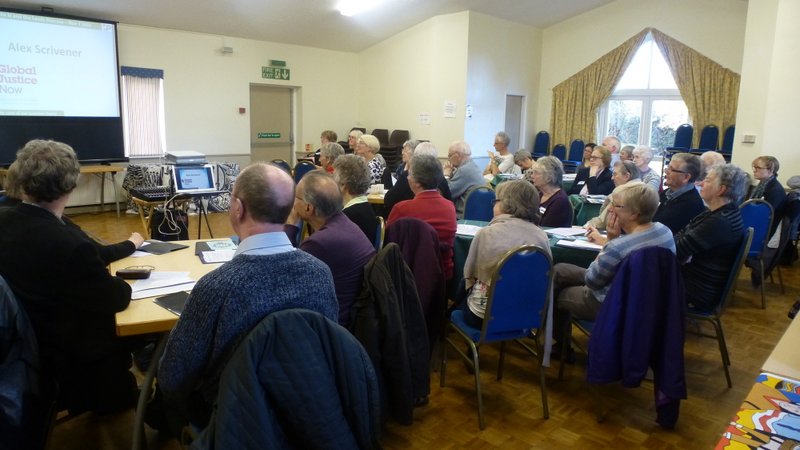
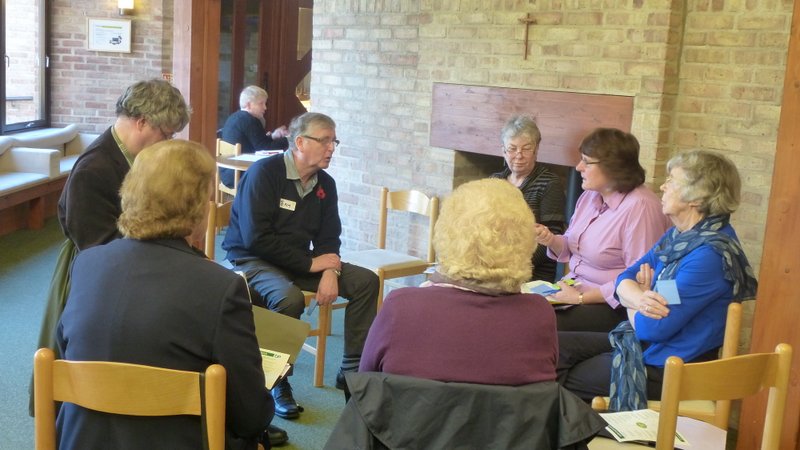
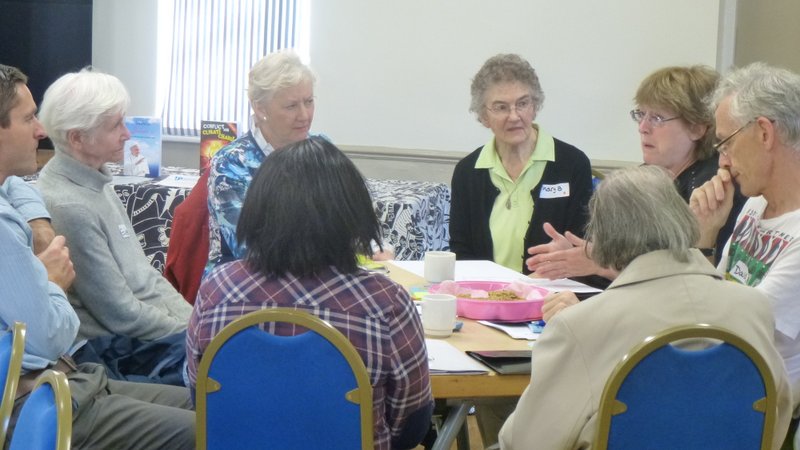
The second of our Open Meetings took place in Bradford at St.Cuthbert’s church hall, part of the parish of St.Cuthbert & First Martyrs on Wed 24 Feb.
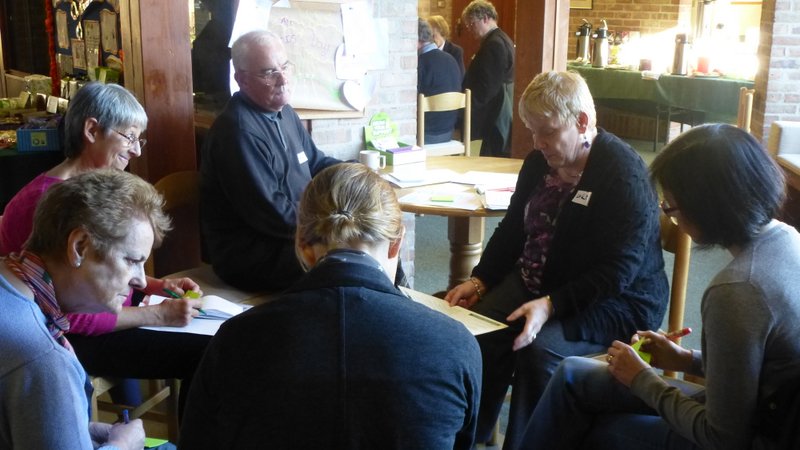
The idea of these meetings is to have an exchange: for members of the Commission to talk about the work that the Commission has been doing and to give the opportunity for people in local areas to talk about their own social justice concerns and what they have been up to in their own church communities.
People from three different parishes in the Bradford area came along to join in the discussion.
At our first Open Meeting – in Skipton – the plight of refugees featured prominently in discussions; it was the same in Bradford, with particular reference being made to Abigail Housing which supports destitute refugees and asylum seekers in a similar way to St.Monica’s Housing in Leeds.
Similarly, the increase in UK poverty aroused a lot of discussion – with people actively involved in local food banks, the plight of homeless people and with the provision of housing for ex-prisoners.
The St.Cuthbert’s church community had recently introduced “Messy Church” sessions.“Messy Church”, which originated in other Christian churches as a way of better involving all age groups, has become increasingly popular amongst Catholic parishes as a way of better engaging with families. At St.Cuthbert’s they have been successful in reaching out to local families. The complication is that the majority of people coming along are Muslims. Consequently, much greater thought has to be given to any prayers or inputs that are provided so that they work in an inter-faith context. It is proving to be a good motivation for exploring spirit-based ethics and focussing on commonalities! It is early days as yet but It has the potential to be a real ‘bridge builder’ between the Catholic and Muslim communities in the local area.
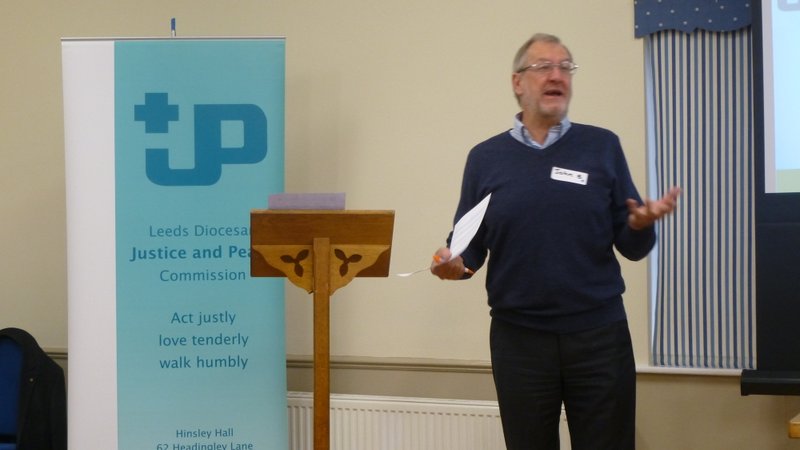
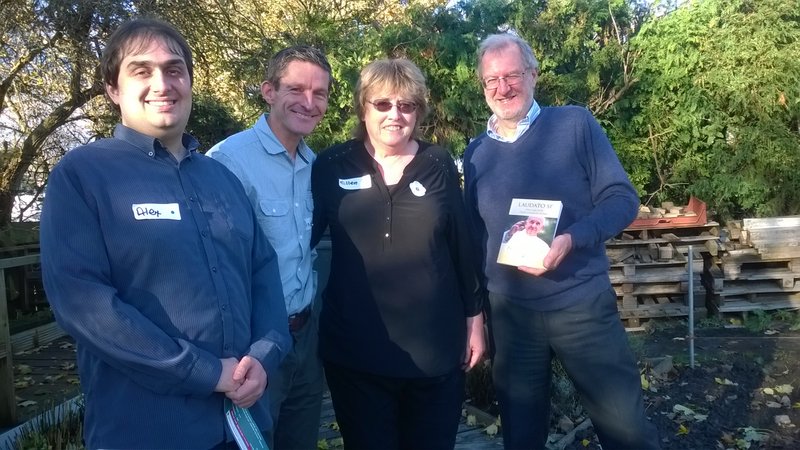
Chair of the Commission, John Battle, talked about the Commission’s conference on Climate Change and how Christians of all varieties have shown a great interest in the Pope’s encyclical ‘Laudato Si’. People at the meeting agreed that Climate Change was important and raised a number of questions that warrant further examination by the Commission. For instance, what is happening at a diocesan level to move towards being a fossil fuel-free diocese?
This write up also appears in the December 2015 Newsletter
Commission members, at the moment, mainly come from Leeds. To ensure that we understand better what social justice campaigning and other activity is going on around the diocese we are planning on having meetings across the diocese over the course of the next 12 months.
The first of these was held at the invitation of the Justice & Peace group at St.Stephen’s church in Skipton.
We opened the meeting with a short reflection using just some key sentences from ‘Laudato Si’ which were shown along with some images. We finished off with the Prayer for our Earth- also from ‘Laudato Si’. This has been printed by the Commission onto a Prayer Card and free copies of this are available from the J&P office.
John Battle Gets Expansive
There were half a dozen members of the Commission there and about 20 people from St.Stephen’s and the surrounding Craven district. John Battle introduced the members of the Commission who were there and asked them to say a little about themselves before he went on to talk about what the Commission had been up to in the last 12 months. He then invited everyone to share who they were and what was happening in and around Skipton and the rest of the Craven district – and their own views about social justice priorities. Those attending included two Methodists who John made especially welcome.
It was not long before the Refugee Crisis came into the discussion. Judy Rogers, who is a member of the Craven Refugee Support Network, talked about what they are doing. Some well-attended meetings have been held at the Quaker meeting house to discuss how people in Craven District might help. People from all denominations and none were keen to get involved. Members can and do join in with activities around donating things for use by refugees and campaigning to try and ensure that they are treated justly both before they arrive and once they get to this country.
The other major need is the provision of suitable housing. It was recognised that there probably will not be a large demand for this in a rural area like Craven District. However, what they do have are the beautiful Yorkshire Dales. With this in mind, the group has decided to provide a residential weekend in the Spring for up to 30 refugee families to provide them with a weekend away. This is being done in conjunction with the City of Sanctuary movement in Bradford. They are in the process of developing a programme for the weekend. It will include different activities on the Saturday and a shared lunch on the Sunday. They are working to get support for the idea of the Mayor of Skipton holding a civic reception for the families on the Saturday.
Comments were also made about the impact that the refugee crisis (let alone the Paris bombings) is having on Muslims in our local communities. A recent art-based project at Ermysteads Grammar school had surfaced some of the apprehensions felt by the Muslim members of that school community.
Sheila Gregory spoke about the small Justice & Peace group that operates in St.Stephen’s parish. They alternate between tackling international issues and more national and local issues. In advent, for example they are looking at homelessness in their local area and the Franciscan Friars of the renewal are coming to give a talk. During Lent they usually undertake awareness-raising and campaigning work. Often this is linked with CAFOD’s lent appeal.
Maggie McSherry, from Settle, built on both previous sets of comments. She explained how in Settle the Churches Together organisation have an ecumenical Justice and Peace Group. They have worked in this way for the last couple of years and feel it has had some successes. In relation to the Refugee Crisis she mentioned about the SVP organising prayer vigils to take place on or around December 10 (International Human Rights Day).
Following up Judy’s comments, Sheila Gregory thought that there was much for follow up ecumenically. This was echoed by others with one person commenting that the problems for Christians is to get a big enough response to make a difference and –hence -there is an imperative to work ecumenically.
Mark Bentley from the Craven Development Education Centre was also in attendance. He explained some of the work that they had been doing with schools and about the special project that had produced resources for schools about Magna Carta (one of the Magna Carta Barons came from Skipton).
Lucy Irven is the manager at the Food Bank in Skipton. She attended the J& P conference “Food Banks: Charity or Injustice?” that the Commission organised in the early part of 2015. She had taken away the real need to act at a public level through lobbying MP’s and other decision makers. Another attendee remarked that groups often find it difficult to know where to start when it comes to lobbying. There is no easy answer to this and perhaps this is an area where the Commission could help.
Outreach in schools and colleges (and not just catholic ones) was also identified as a gap. The Commission does not have the resources to do much direct work in these contexts. However, it could investigate providing better signposting to existing resources ( such as the Development Education Centres in the area of the diocese and the promotion of the work of the Pax Christi Education worker ) – and looking to work with others to raise awareness about both key issues and Catholic Social teaching.
The Commission thanks everyone who came along and joined in wholeheartedly in the discussions. Special thanks to Lucy Irven for inviting us in the first place and then making the arrangements and providing refreshments. Thanks also to Fr.Andrew Summergill, the parish priest at St.Stephen’s.
After John Battle (Chair) had taken us swiftly through what the Commission had been up in the last 12 months we moved into a half-day of hearing about, discussing and committing to action about Climate Change.
Ellen Teague, catholic journalist and part of the Columban JPIC team, went through some of the key concepts in the encyclical. Part of what Andy Challinor (Professor of Climate Impacts at the University of Leeds) spoke about was the importance of the framing of the debates about Climate Change. The predominant narrative is one where technological solutions (such as carbon capture or GM crops) are the principal means of mitigating the worst effects of Climate Change and ensuring that the world has enough to eat over the next 50 years. A lot of the debate is framed around assumptions about food requirements in the next generation. Andy suggested that there is an alternative narrative to be explored by varying the key assumptions. The majority of studies relating to this assume that consumption patterns stay the same in the next generation. What if they changed? – What if people wasted less food and materially changed their diet? – This may provide a way of both mitigating some of the effects of Climate Change and improving public health at the same time. However, little work has been done to date on exploring these other options.
This idea of an alternative narrative was taken up by Alex Scrivener, from Global Justice Now. He was very pessimistic about the outcomes from the upcoming Paris Climate Change conference. Too many vested interests from the rich countries and from multinational corporations will ensure that any agreements do not deliver the radical changes that are needed, he thought. However, rather than getting totally depressed about this situation, Alex recommended that campaigning actions are needed but that the focus needs to be different. The pope’s analysis in ‘Laudato Si’ he thought was very helpful in this regard. The pope calls on people to undergo an ‘ecological conversion’. However, he does not stop at saying that we should all change our own way of living but insists that we need to act together to overcome Climate Change issues.
Alex and Ellen were critical of the role of multinational corporations and this was something that was questioned in the panel discussion that was a later feature of the conference. Some people argued that they exist and are not going away so we must lobby them to change the way they operate. However, Alex disagreed. Some multinationals, he maintained, were not interested in changing and he likened the situation to the late eighteenth century when discussions about the slave trade were ongoing. “I’m sure some people had similar feelings then: the slave traders are not going to go away so perhaps we can get them to be a bit more humane – give people double rations, or something similar”, he remarked. “In 100 years’ time there are a number of corporations that should just no longer exist”.
Both Alex and Andy commented how, in their preparation for this conference, they were surprised to discoverthat the pope’s encyclical connected their worlds of science and theology on the one hand and campaigning and personal conversion on the other.
In small group discussions, people were asked to commit to one personal action (changing something about the way they lived) and to one public action (such as lobbying their political representatives or joining in other group actions about Climate Change). Over 200 actions were logged. The conference may have raised more questions than it answered for many people – but there was a palpable desire from many attendees to explore the questions in more depth and to take more action.
Ellen Teague also has a report about the conference on the Independent Catholic News website:-
John Battle introduces the conference and talks a little about what the Commission has been up to over the last 12 months
Alex Scrivener, Policy Officer with Global Justice Now, addresses the conference. He said he was going to be \’unremittingly pessimistic\’! However, this was only in relation to what he thought might be achieved via the Paris Climate Change Conference in December (very little). More optimistically, he was convinced that change is possible – but that it is down to all of us to ensure that MP\’s and other political representatives get the message that, like the pope, we are up for some radical changes that address the interlinking of climate change with poverty, trade injustice and other issues.
Conference attendees listening to Alex Scrivener
Small discussion groups were used to provide time for people to think about what action they could take (1) at a personal level (like using their car less) and (2) at a public level (by, for example, engaging with political representatives).
Another small discussion group
Another small discussion group
Another small discussion group.
Another small discussion group.
Another small discussion group.
Another small discussion group – with one of our other keynote speakers (Ellen Teague) top centre.
Another small discussion group.
Alex Scrivener, Prof Andy Challinor and Ellen Teague with Commission Chair John Battle. They are outside taking a look at St.Benedict\’s garden. For the last 2 years St.Benedict\’s parish has been working towards becoming a LiveSimply parish and the garden (which does grow some flowers but is mainly used for fruit and vegetables) is one way in which they have been pursuing this goal.
Attendees at the conference listening to one of the speakers.
This conference was organised jointly by the Commission and the Leeds Pax Christi group.
We are grateful to the Christian Peace Education Fund which provided some financial support to the event. It was organised as part of the World Council of Churches\’ World Week for Peace in Israel and Palestine.
It followed the format of our conference earlier in the year about food poverty where there were a series of shortish presentations with liturgical elements integrated across the timespan of the conference. It was a great opportunity to find out more about the situation there and reflect on it. Whilst the situation will only improve materially through political actions, the conference also included time to think about the practical things that each of us can do to help the situation and put pressure on politicians across the world to implement a just solution.
Mary Lucas, from CAFOD, provided some historical background and spoke about CAFOD\’s work in the Occupied Territories (the West Bank) today.
Tricia Griffin from Leeds spoke about her time in Bethlehem as an \’Ecumenical Accompanier\’.
Deacon David Arblaster, from Harrogate, gave some food for thought about the theological context of the current situation with a wide-ranging review that included thoughts from a prominent Islamic scholar.
50 people attended the conference – and they must have enjoyed it as they nearly all stayed on to share some lunch in the cafe at the Oxford Place centre.
Attendees at the start of the Conference
The conference started with an opening liturgy.
Shelagh Pickles, from John Henry Newman parish in Cross Gates, reads a scripture passage as part of the opening liturgy
Mary Lucas from CAFOD describing the work that CAFOD undertakes today to support Palestinians both in the West Bank and in Gaza. One of the organisations that CAFOD supports is the Ecumenical Accompaniment programme of the World Council of Churches.
Tricia Griffin tells the conference about her experiences as an \’ecumenical accompanier\’. She spent 3 months in Behtlehem and part of her role was spent accompanying people as they queued to get through checkpoint 300 early in the morning in order to get to work on the Israeli side of the Separation Barrier. Accompaniment by international observers such as Tricia is an important way both of showing solidarity with the plight of the Palestinians and of moderating the actions of the Israeli military.
David Arblaster spoke passionately and authoritatively about why Christians should be concerned by what is happening to Palestinians today – and particularly people in the UK, because of our historical involvement
Carol Burns, Conference chair, leads a small discussion group enabling people to respond to what they have heard and to think about they can do.
Margaret Scally, of the Leeds Pax Christi group, leads a small discussion group.
Deacon David Arblaster leads a small discussion group
This wonderful Olive Tree was made by Ginia Harington, another member of the Leeds Pax Christi group. In the small group discussions people were encouraged to think of one action they could commit to and to write that down on a paper \’olive leaf\’. Then, as part of the final liturgy, everyone came up and hung their actions on the Olive Tree.
Some of the products available on the Zaytoun products stall at the back of the conference hall.
The Commission agreed that it should start to make more details of its meetings available via this website.
So here they are! – but rather than present the minutes per se we will attempt to convey the key points of each meeting so you can get a flavour of what was discussed.
New website
Our new website has now been live for over a month and new content is being added all the time. When there is little money available, a website becomes a lot more important as a way of engaging with everyone in the diocese.
Improving Participation in the Commission
It might be called the ‘Leeds’ diocese, but the Commission is only too well aware that the diocese includes Bradford, Huddersfield, Halifax, Wakefield and places like Skipton, Settle and Selby. So, we put an invitation in the last newsletter to see if parishes around the diocese would be willing to host a Commission meeting. We have received an invitation from Skipton and the Commission agreed that a meeting in late November would be held there. The idea is that we reserve half the time available for items that people from that area want to raise with the Commission. Another invitation has since been received to host a meeting in Bradford and we will look to do this in the first quarter of 2016.
The Refugee Crisis
This was the biggest item on the agenda of this meeting. The current situation is clearly a Social Justice priority – and refugees have long been high on the Commission’s agenda. The Commission was instrumental in the setting up of St.Monica’s Housing, which has provided support and accommodation to failed asylum seekers in the last few years. Commission members continue to be active in this endeavour and the Bishop has asked St.Monica’s to be firmed up into a Trust and Taskforce for the diocese. Our Chair, John Battle, has been asked (alongside the SVP lead for the diocese and others) to help co-ordinate the practical response of the diocese to the situation.
People naturally want to respond. However, those responses need to be appropriate and need to address the real needs of refugees. Many of those coming will be vulnerable children and adults or people with injuries or other special needs and aspects of care and safeguarding need to figure strongly in relation to any proposed action. The Commission is encouraged by the coming together of groups, both faith-based and secular, in Leeds and Bradford. This will ensure that responses are co-ordinated and efforts are not wasted.
Conferences
The preparations for our conference about Palestine at the end of September are progressing well and the Working Party are sure that attendees will find it a rewarding event.
Our AGM and half-day conference about Climate Change have been set for Nov 7th. St.Benedict’s in Garforth is the venue. This location was chosen because, although not a city centre location, it is easy to get to by public transport (being only a 2 minute walk from Garforth station). It also has a long history of hosting such events.
Speakers have been lined up and marketing of the event will get underway shortly. Given the interest already displayed in the pope’s encyclical we are hopeful that this event will appeal to a wide range of people who want to find out more and work out what actions they can take in their own parishes.
This was the 37th Conference organised by the National Justice and Peace Network (NJPN). Over 300 people from all around the country gathered at the Swanwick Christian Conference centre focussed around the theme of \’The Things that make for Peace\’.
These conferences are a mix of keynote speakers, panel discussions and workshops.
Prof.Paul Rogers, of Bradford University gave a wide-ranging review of the current state of the world and talked about the difficulty for alternative voices to be heard above the prevailing neo-liberal political consensus.
Fr.Edu Gariguez spoke about how he was an \’accidental environmentalist\’. He started out working with indigenous peoples on the island of Mindano in the Philippines. However, their concerns centred around a huge proposed nickel mining operation that would have had devastating effects for their way of life and so he became heavily involved in environmental activism and in 2012 won the Goldman environmental prize.
Commission member Trish Sandbach chats with Prof. Paul Rogers during the \’Just Fair\’ that regularly accompanies the conference.
Mollie & David Somerville from Bradford
Anne Peacey of NJPN presents some flowers to Pat Gaffney (General Secretary of Pax Christi UK). Pat chaired the conference weekend but the flowers were really to celebrate her 25 years working for Pax Christi and to thank her for all the outstanding work for peace that she has undertaken during that time.
Around seven hundred people gathered at the Centenary Pavilion of Leeds United to join in the Founding Assembly of Leeds Citizens. The Diocese of Leeds is a founding partner of Leeds Citizens and the Justice and Peace Commission is also a member. The date was deliberately chosen to show how people in Leeds have come together since the bombings of ten years ago in London.
The Leeds Diocese is obviously a lot wider than Leeds. However, such an important initiative deserves the support of both the Diocese and the Justice and Peace Commission. Is this model of bringing communities together to enact change for the ‘Common Good’ one that could work in other areas in our diocese? – So far, it has certainly been successful in bringing together all manner of churches, mosques, temples and people of no faith in Leeds.
Leeds Citizens Founding Assembly Photos
Over 700 people gathered for the Assembly.
Dr.Ann Marie Mealy with Tom Chigbo. Tom is the worker for Leeds Citizens. Ann Marie is both a member of the Commission and represents Leeds Trinity University at Leeds Citizens.
Tom Riordan, CEO of Leeds City Council, and Judith Blake, Council Leader.
They committed to getting the council and their service providers to work towards paying a living wage.
Prof.Margaret House, Vice-Chancellor of Leeds Trinity University addressed the Assembly on behalf of all the Founding Members of Leeds Citizens.
Adrian Strain, from John Henry Newman parish in Leeds, makes an impassioned plea for better access to mental health services and better ways to signpost people to the right services for them.
Young Peace Ambassadors report back on the visit they had made to London to commemorate the 7/7 bombings.
The Climate Coalition brought together hundreds of different organisations to take part in a mass lobby of MP’s to ensure that all our newly elected MP’s understood the strength of feeling in the country about the impacts of Climate Change and that we want the Government to support concrete action to reduce carbon emissions. At an international level, lobbying was also about ensuring that special help is made available to poorer nations – as these are the countries who are least able to manage the changes that will need to take place to ensure that people continue to have sustainable livelihoods.
Climate Change Lobby - Photos
CAFOD Supporters gather
Hundreds of people attended an ecumenical service before the actual start of the Lobby.
A CAFOD speaker from Niger tells the congregation about how Climate Change is affecting his country.
The Bishop of Salisbury addressed the Ecumenical service. \”If a doctor told you that he was 95% certain that you had a serious disease – BUT he could give you some medication that would cure it – then you would take the medicine. It should be the same with Climate Change.\”
Hilary Taylor with Some \’For the Love of…\’ hearts signed by people from her church community of St.Mary\’s, Horsforth – part of Our Lady of Kirkstall parish.
Lobbyists from Bradford- including Justice & Peace stalwarts Mollie & David somerville.
Michael Emly and Joe Burns from Our Lady of Kirkstall Parish in Leeds with their MP, Greg Mulholland.